Two kinds of plant first.
Senate starts with automotive suppliers and consumer packaged goods, the two industries where ERP setup costs the most. A company begins from a starter for its country and industry, not from a blank system.
10StarterOne per country and industry
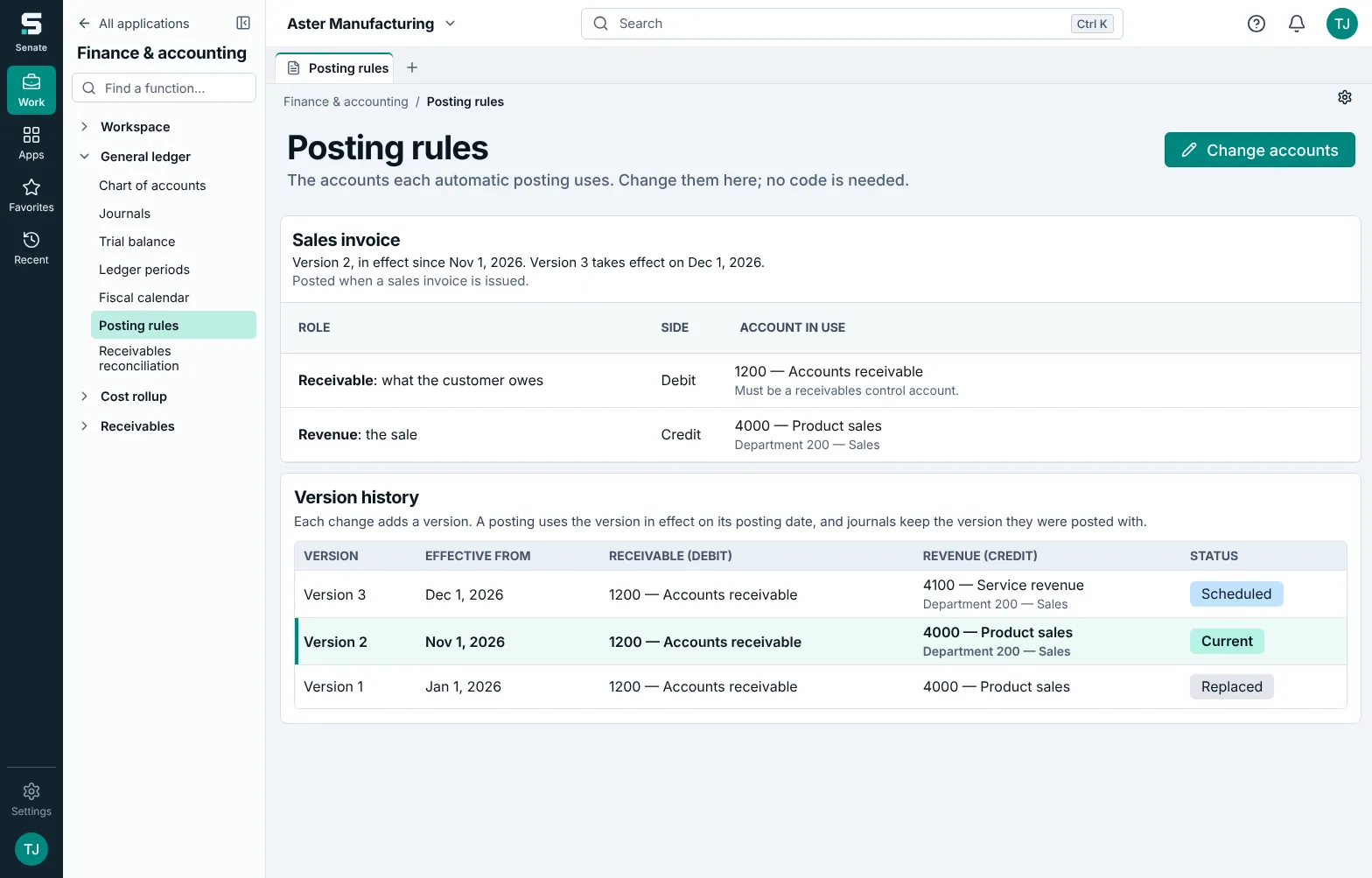
A company starts with its books already set up.
A starter holds what every plant of that kind needs on the first day. You adjust what is different about your plant, or start over and upload the chart of accounts you use today. Starters for automotive and CPG are in development.
What a starter contains
- 01Chart of accountsSegments you can add to later.
- 02Fiscal calendarPeriods ready to open.
- 03Posting rulesVersioned, per document type.
- 04RolesEight to start, with permissions you can change.
- 05Document templatesQuotes and invoices, copied and edited without code.
One starter, general manufacturing, is in the build, and a company can also start blank. Starters for automotive and CPG are in development.
20IndustryTier suppliers
Automotive suppliers
Tier suppliers run on customer schedules, customer labels and standard cost, with margins that leave little room for rework. Senate plans, costs and posts in one system so the plan, the floor and the ledger agree.
- The customer moved the release again overnight, and tomorrow’s truck still has to be right.
- Their label, their format, their barcode. Get it wrong and the shipment is charged back.
- If a part is questioned, every lot has to trace back to the material it came from.
- Standard cost is the cost. The variances say where the money went.
- Forecasts, ship schedules and ship notices arrive and leave as EDI.
Where Senate stands for automotive suppliers
| What you need | How Senate handles it | Today |
|---|---|---|
| Customer orders | Quotes, sales orders, shipments and invoices, with attachments and a full audit trail. | In the build |
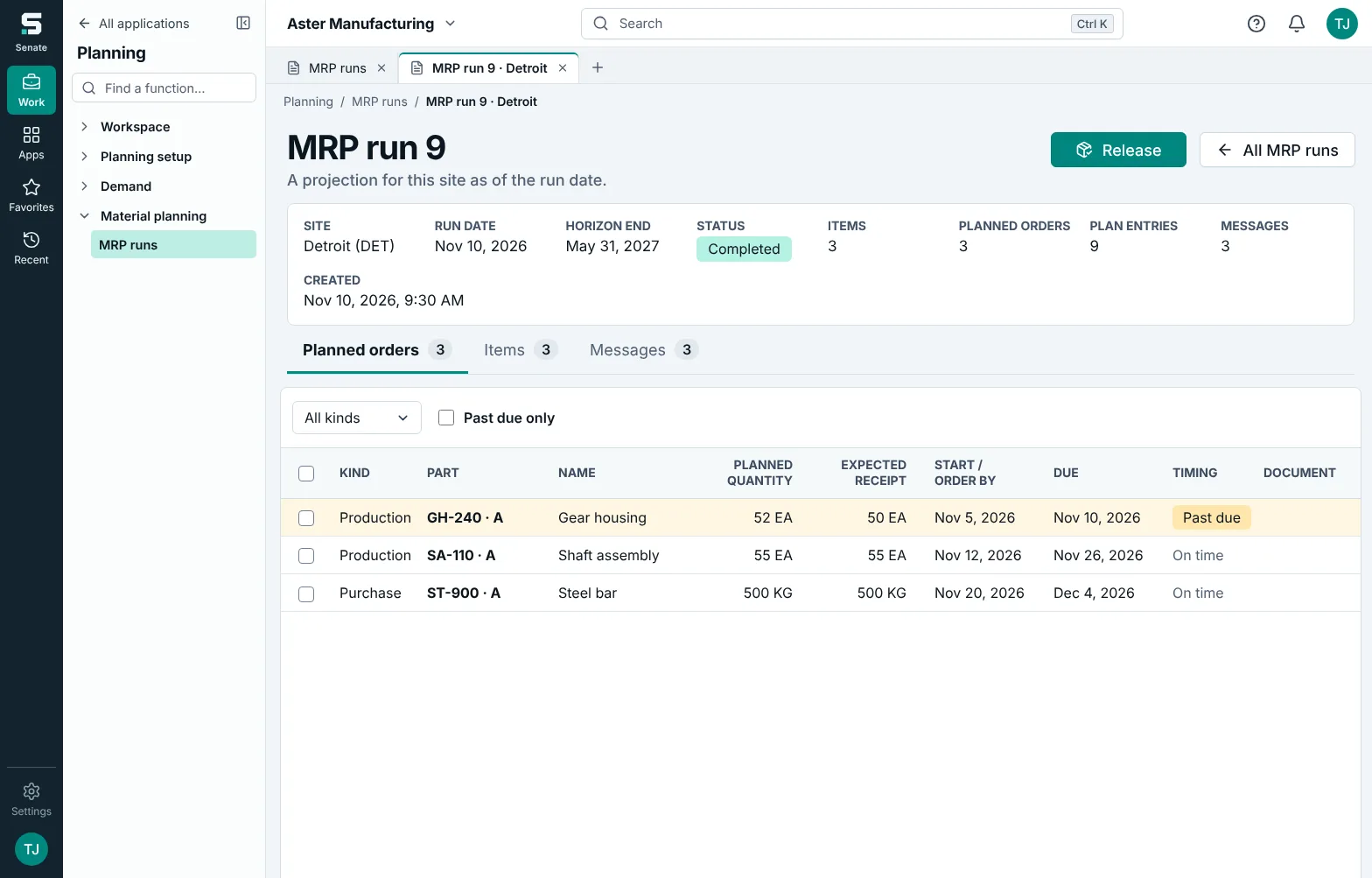
| Material planning | MRP runs against demand forecasts and open orders through every level of the bill, with planning rules set per part. Planned orders are released into draft purchase orders and work orders. | In the build |
| Product structure | Bills of material that MRP explodes into planned production and purchase orders. | In the build |
| Standard cost and the ledger | Standard cost is the official costing method. Chart of accounts, journals, posting rules, periods and trial balance in a ledger Senate owns. | In the build |
| Shop-floor reporting | An operator control center for production, scrap and labour and machine hours, and for completing operations and work orders. | In the build |
| Customer-specified labels | ZPL rendered on the server and sent through a print agent at the site, with browser printing for USB Zebra printers. | In development |
| Make-to-order | Options chosen on the order line, so one part number can carry the configuration the customer ordered. | In development |
| Releases and shipments | Shipments against sales orders, and customer schedules whose releases are reconciled by cumulative quantity. Blanket orders come next. | In the build |
| EDI | Senate builds the business side: customer schedules, ship notices and invoices. A connected EDI provider keeps each trading partner’s maps and handles translation and transport. Senate does not build EDI translation. | In development |
| Control plans and FMEA | One quality plan holds the process steps, a process FMEA in the AIAG and VDA form, and the control plan, so they cannot drift apart. The inspections operators fill in come from the control plan. | In development |
| Part approval (PPAP) | A part approval with the AIAG checklist of elements, each filled from a plan, a check or a file you already have. It keeps the records an IATF 16949 audit asks for; it does not certify anything. | Planned |
| Lot traceability | From the material received to the lot shipped, in both directions. | Planned |
30IndustryFast lines, many SKUs
Consumer packaged goods
CPG plants turn forecasts into cases and pallets at speed, then hand every customer the data in the shape that customer asks for. Senate plans from the forecast and opens every module to integration from the start.
- Hundreds of SKUs, and each one has its own case and pallet.
- The line runs fast. Boxes and labels come off it faster than anyone can key them in.
- Every retailer wants orders, ship notices and data their own way.
- A promotion pulls demand forward, then the weeks after it go quiet.
- Every lot carries its dates, and every case has to be traceable to one.
Where Senate stands for CPG plants
| What you need | How Senate handles it | Today |
|---|---|---|
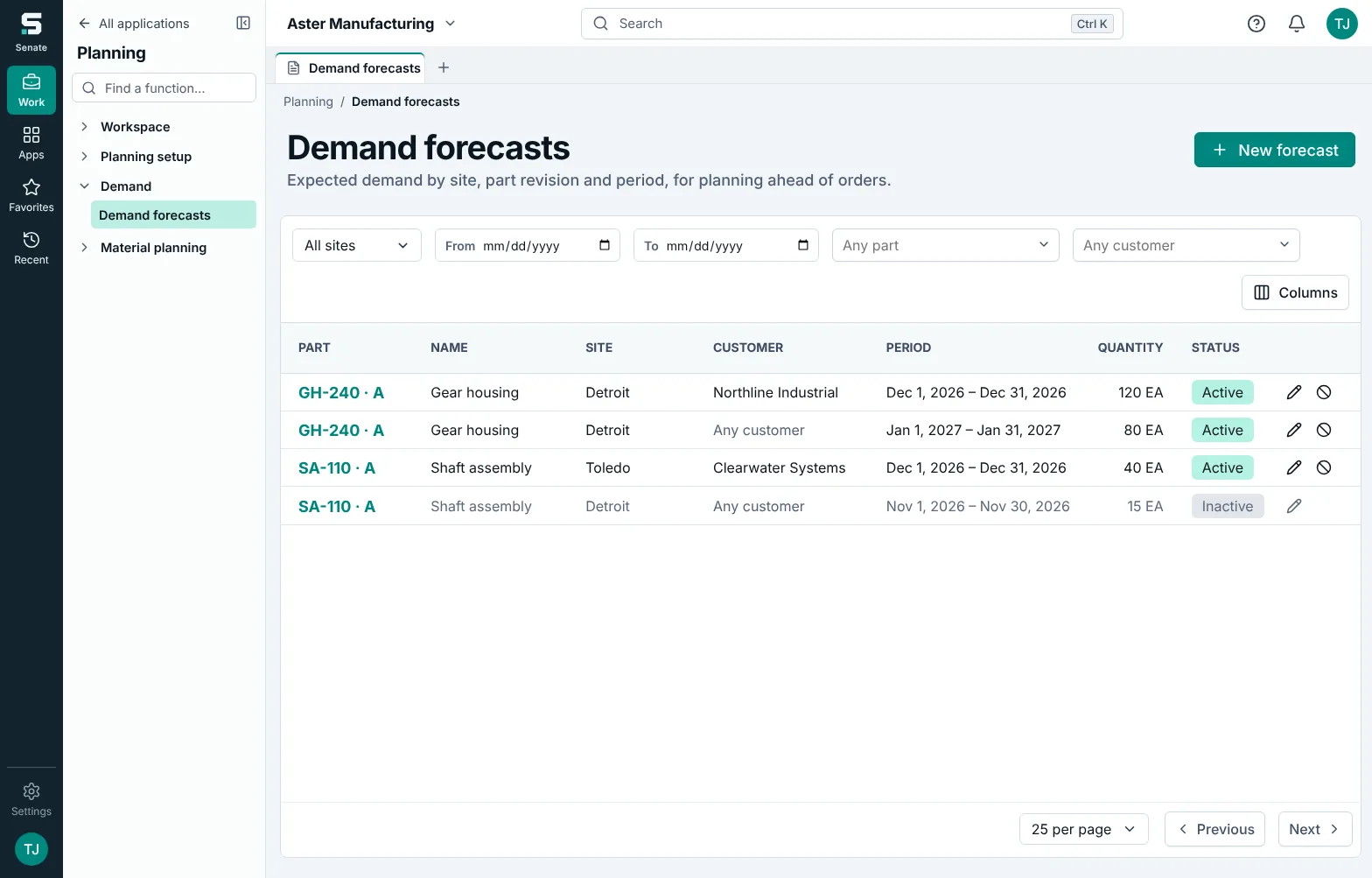
| Forecast-driven planning | Demand forecasts per part feed MRP runs alongside open orders. | In the build |
| Formulas and pack structures | Bills of material hold what a CPG plant may call a formula or recipe, through to the finished case. | In the build |
| Data each retailer’s way | A documented REST API and business events on every module, under the same permissions as the screens. | In the build |
| Data from the old system | Upload a CSV or Excel file, map its columns to fields, including ones you added, preview every failure, then import. | In the build |
| Line-side reporting | Three reporting modes: periodic recording for slow bin fill, fast lines producing many boxes and labels, and full pallet labels. | In development |
| Push to partners | Webhooks that notify a partner system when a business event is committed, for every kind of record. | In the build |
| Customer classifications | Customer type, customer group and similar lists, set up as independent lists, hierarchies or allowed combinations, and enforced on every write. | In the build |
| Pricing and trade terms | Price lists, discount agreements and rebates. | Planned |
| Lot traceability | Lots followed from ingredient to shipped case, in both directions. | Planned |
| HACCP plans | Hazards, critical control points and preventive controls on one quality plan, with limit readings and cleaning recorded as checks on the line. | In development |
| FSMA records | The written hazard analysis, preventive controls, monitoring and record review that the FSMA preventive controls rule asks for. Traceability records come with lot traceability. | Planned |
| SQF and BRCGS audits | Food safety plans, cleaning programs and internal audits kept as plans and checks, so the records are ready when the auditor asks. Senate does not certify a plant. | In development |
| Sales tax | Tax content from Avalara AvaTax through a connector, so rates stay current without anyone maintaining them. | Planned |
40One product
Same product.
Different starter.
Other industries are not in the first wave. We would rather fit two well than many loosely. Under both, the manufacturing data model is being built on ISA-95, the international standard for plant and business data.
- 01
One version for everyone
An automotive supplier and a CPG plant run the same release of the same product. Neither waits for an industry edition to catch up.
- 02
Configuration, not a fork
A starter is data: accounts, a calendar, rules, roles and templates. You change it the way you change any other setting, and none of it is custom code.
- 03
Kept through upgrades
What you configure stays yours through every release, because there is no customer copy of the product to merge.
50LaunchTwo countries, two currencies
Launching in the United States and Canada.
Senate launches in two countries, so money and dates are handled for both from the start. More regions follow as versioned country packs.
- No bare amounts
- Every amount carries its currency. US and Canadian dollars are never added without an explicit conversion.
- Rounded once
- One rounding service, using each currency’s own minor units.
- The site’s own date
- Business dates follow the time zone of the site that did the work, never the server’s or the browser’s. A journal posted at the same instant in Vancouver and Detroit can carry two different business dates.
Bring a customer export.
Join the early-access list. We load your customers from the file you already have, and you see the product with your own data in it.